How to Get to Jukseong Church from Busan Station
The most dependable public-transport route from Busan Station to Jukseong Church is to take Metro Line 1 to Bujeon, transfer on foot to the Donghae Line at Bujeon Station, ride to Gijang Station, then take Gijang-gun Village Bus 6 from the Gijang Catholic Church stop to Jukseong Dream Filming Set. Allow about 90–120 minutes because the rail-to-village-bus connection can involve waiting.
Jukseong Church is not an active parish church. It is a seaside filming set built for the 2009 Korean drama Dream. Its red roof, lighthouse-style tower, rocky coast, and open sea make it one of Gijang’s most photogenic stops, but its location outside central Busan requires careful transfer planning.
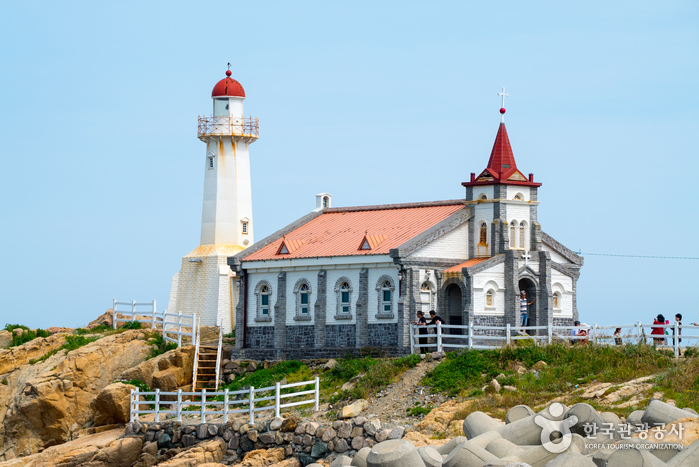
Busan Station to Jukseong Church at a glance
- Best rail route: Line 1 to Bujeon, Donghae Line to Gijang
- Final bus: Gijang-gun Village Bus 6
- Bus stop: Jukseong Dream Filming Set
- Total time: roughly 90–120 minutes each way
- Korean name: 죽성성당(드림세트장)
- Address: around 2-7 Duho 1-gil, Gijang-eup, Gijang-gun, Busan
- Admission: free
Save the Korean destination and take screenshots before leaving central Busan. Village buses can be infrequent, and a missed connection matters more here than it does in downtown Seoul or Busan.
Step-by-step public transport route
1. Take Busan Metro Line 1 to Bujeon
Enter the subway at Busan Station and board Line 1 toward Nopo. Get off at Bujeon. The metro station and the Donghae Line railway platforms are separate, so follow signs and allow time to walk between them rather than expecting a same-platform transfer.
2. Take the Donghae Line to Gijang Station
At Bujeon Station, board a Donghae Line train traveling east toward Gijang and the coastal side of Busan. Check the platform display before boarding. The Donghae Line is a commuter railway, not Busan Metro Line 2, and service intervals are wider than on the central subway.
3. Leave Gijang Station through Exit 1
Current Visit Busan directions use Exit 1. Walk to the Gijang Catholic Church stop, shown in Korean as 기장성당. Do not simply wait at the first bus stop outside the station; use Naver Map or KakaoMap to locate the exact boarding point.
4. Take Gijang-gun Village Bus 6
Board Gijang-gun 6 and get off at Jukseong Dream Filming Set (죽성드림세트장). From the stop, the official walking direction is about one minute. Tap your transportation card when boarding and exiting, and watch the live stop display because English announcements may be limited.
Why the final bus is the difficult part
The Donghae Line segment is straightforward, but Village Bus 6 can make or break the trip. It serves local neighborhoods rather than operating as a frequent tourist shuttle. Check the live arrival before leaving Gijang Station and note the return bus at the same time.
If the wait is long, a taxi from Gijang Station is a practical fallback. Show the driver 죽성성당 드림세트장. For two to four travelers, splitting the short local taxi may be worth the time saved. Ask to be dropped at the filming set, not at an unrelated church with a similar name.
Is a taxi from Busan Station worth it?
A direct taxi avoids two transfers but covers a long distance across the city. Travel time and fare rise sharply in congestion. It makes most sense for a group, travelers with limited mobility, or anyone combining several Gijang attractions with a hired vehicle.
A better compromise is rail to Gijang Station and taxi only for the final segment. The train avoids most road traffic while the taxi removes the uncertain village-bus wait. Keep the return destination saved as 기장역 if you plan to use the same method back.
What to expect at Jukseong Church
The building looks like a small coastal cathedral, but it was created as a television set. Do not arrive expecting a Mass schedule, parish office, or historic religious site. The interior may function as a gallery when an exhibition is running, while the outdoor view is the main attraction.
The site is officially listed as open year-round and accessible around the clock, but that does not mean every interior space or exhibition is always open. Weather, maintenance, and local events can change access. The exterior and coast are the reliable parts of the visit.
Most visitors need 30–60 minutes. The grounds are compact, so this is not a full-day destination by itself. Extra time is useful for photographing the building from different angles, watching waves, and walking carefully around the nearby rocks.
Best time for photos
Morning gives the coast softer light and fewer visitors, and the location is known for sunrise scenery. Midday produces a strong blue-sea look on clear days but also hard shadows. Late afternoon can be pleasant, though the building’s orientation and seasonal sunset position affect the result.
Wind is the most important practical issue. Gijang’s open coast can feel much colder than central Busan, and spray makes rocks slippery. Avoid standing near an exposed edge for a photo. A zoom lens or phone zoom is safer than climbing over barriers.
A realistic Gijang day itinerary
- Leave Busan Station early and take the Donghae Line to Gijang.
- Visit Jukseong Church before the busiest photo period.
- Return to Gijang for lunch at the market.
- Continue to Haedong Yonggungsa or Songjeong only if your energy and bus timing allow.
- Return to central Busan by Donghae Line before the evening rush.
For lunch, our Busan Station to Gijang Market guide explains the seafood-market stop and practical ordering considerations.
Haedong Yonggungsa is farther along the eastern coast but requires another local transfer. Use our Haeundae to Haedong Yonggungsa guide and do not assume the two places are walkable.
Songjeong Beach is another reasonable coastal stop connected to the Donghae Line area. Our Busan Station to Songjeong Beach guide helps decide whether to add the beach or return directly.
Accessibility and practical cautions
The main viewpoint is close to the local stop, but coastal paths can be uneven and the rocky area is not step-free. Travelers using a wheelchair or stroller should confirm current access conditions locally and consider a taxi for the final segment.
- Wear shoes with grip rather than smooth sandals.
- Bring wind protection outside summer.
- Carry water; do not rely on a café being open beside the set.
- Keep voices low around the fishing village.
- Do not photograph residents or working boats closely without permission.
- Check the return bus before beginning a long coastal walk.
Common mistakes to avoid
- Believing it is an active Catholic church
- Confusing Bujeon Metro Station with the Donghae Line platforms
- Waiting at the wrong Gijang Station bus stop
- Ignoring the return schedule for Village Bus 6
- Planning only 30 minutes for the entire Gijang detour
- Climbing wet rocks for a photograph
FAQ: Jukseong Church from Busan Station
Is Jukseong Church a real church?
No. It is a filming set built for the 2009 drama Dream. The interior may host gallery exhibitions, but it is not an active parish church.
How do I get there from Gijang Station?
Use Exit 1, walk to the Gijang Catholic Church stop, take Gijang-gun Village Bus 6, and get off at Jukseong Dream Filming Set.
How long does it take from Busan Station?
Allow about 90–120 minutes each way by public transport, depending on the Donghae Line and village-bus connection.
Is there an entrance fee?
No. Official tourism information lists the filming set as free. Special gallery access can depend on whether an exhibition is operating.
Can I visit at sunrise?
The outdoor site is listed as open 24 hours, and sunrise is popular. Arrive quietly, check the first available transport, and use extra caution on dark or wet paths.
How long should I stay?
Thirty to sixty minutes is enough for the compact set and coastal views. The transfers make it sensible to combine the visit with another Gijang destination.
Local takeaway: Use the Donghae Line to Gijang, check Village Bus 6 before leaving the station, and remember that the famous “church” is a seaside drama set rather than a religious attraction.


댓글
댓글 쓰기