Busan to Taehwagang National Garden: Train, Bus, and Bamboo Grove Guide
The easiest Busan to Taehwagang National Garden route is the Donghae Line to Taehwagang Station, followed by a short Ulsan city-bus ride to the Taehwagang National Garden or Donggang Hospital stop. From central Busan, start at Bujeon Station. From Haeundae or eastern Busan, join the Donghae Line at the most convenient station near your hotel. Allow a full half-day, or a full day if you want to see both the daytime garden and the illuminated bamboo trail after dark.
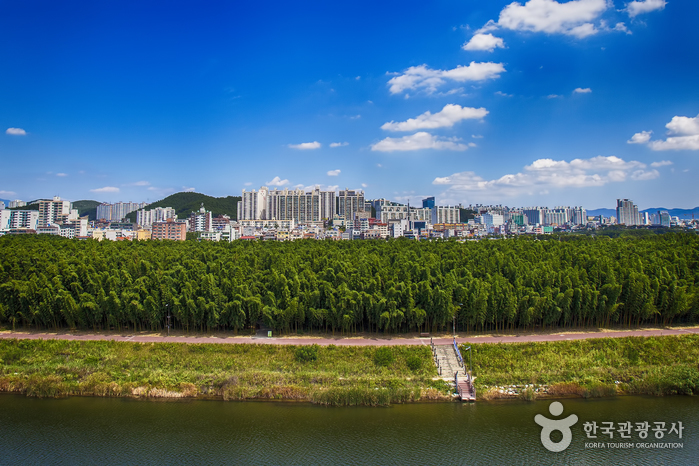
Taehwagang National Garden is a large riverside landscape, not one compact fenced garden. The main practical challenge is choosing the correct arrival point and finding Simni Bamboo Grove without crossing the river unnecessarily. This guide gives a clear route and a realistic walking plan.
Quick route from Busan
- Reach a Donghae Line station in Busan. Bujeon is the usual choice from Busan Station or Seomyeon.
- Take a train toward Taehwagang and get off at Taehwagang Station.
- Outside the station, take a current Ulsan bus to Taehwagang National Garden / Donggang Hospital.
- Start near the information center, then walk the flower gardens and Simni Bamboo Grove.
The garden's official access page, updated in July 2026, lists buses 523, 713, 763, 1115, 1733, and 9001 from Taehwagang Station. You do not need to memorize every number. Enter 태화강 국가정원 안내센터 in Naver Map or KakaoMap and take the first suitable live route.
Step 1: get to the Donghae Line in Busan
From Busan Station
Take Metro Line 1 to Bujeon. Bujeon metro station and the Donghae Line rail station are nearby but require a street-level transfer. Follow signs and leave extra time to find the correct entrance. This is a common point of confusion for first-time visitors.
From Seomyeon
Bujeon is close enough that the same route works well. Depending on your exact hotel and luggage, walking or taking a short metro ride may be more practical. Search the rail station rather than only the neighborhood name.
From Haeundae, Centum, or Songjeong
Do not automatically travel west to Bujeon. The Donghae Line serves eastern Busan, and a station near your accommodation may save time. Compare your live route to BEXCO, Sinhaeundae, Songjeong, or another appropriate Donghae Line station.
Step 2: take the Donghae Line to Taehwagang
Check the platform display and confirm that the service continues to Taehwagang. The Donghae Line is operated as a rail corridor, so its station layout and frequency feel different from the core Busan subway. Give yourself a buffer rather than arriving one minute before a planned train.
Taehwagang Station is not Ulsan KTX Station. The KTX station lies far west of central Ulsan. From Busan, Taehwagang is the logical arrival for the national garden because it connects directly to local buses across the city.
Travelers starting in Seoul have a different station decision. They should use this Seoul to Ulsan KTX day-trip guide rather than copying the Busan route.
Step 3: Taehwagang Station to the national garden
At Taehwagang Station, follow the signs for city buses. Search for the destination in Korean and select a bus that stops at 태화강 국가정원·동강병원. The official list currently includes 523, 713, 763, 1115, 1733, and 9001 from the station.
Bus networks change more often than major rail lines. Use the current official list as a starting point, then trust live navigation for the platform, direction, and arrival time. Save a screenshot of the destination in Korean in case you need to show the driver.
Is a taxi worthwhile?
A taxi from Taehwagang Station is a convenient alternative for a small group, a family, or anyone arriving during a long bus wait. The distance is a normal cross-city ride rather than a walkable station transfer. Check the live estimate before boarding.
Where should you start inside the garden?
Use the Taehwagang National Garden Information Center at 5 Saetgangnam-gil as your map destination. The garden stretches along the river and includes multiple themed areas, paths, parking zones, and river crossings. Starting with a specific pin prevents you from arriving on the wrong bank.
Once there, orient yourself using three landmarks:
- Information center: the practical starting point for maps and current facility information.
- Simni Bamboo Grove: the long shaded bamboo path and the main reason many international travelers visit.
- Riverside flower garden: a broad seasonal landscape whose appearance changes through the year.
A realistic 3-hour walking plan
1. Information center and riverside orientation
Begin by checking the local map and any temporary closures. Walk toward the river and identify the direction of the bamboo grove before exploring smaller themed sections.
2. Seasonal flower gardens
Spend 30–60 minutes in the open gardens. Spring and autumn can bring large flower displays, but planting zones and peak dates change annually. Search recent Korean images for 태화강 국가정원 꽃 if a specific bloom is the main purpose of your trip.
3. Simni Bamboo Grove
Enter the grove for the coolest and most distinctive part of the walk. “Simni” describes the traditional distance associated with the long bamboo corridor; the wider bamboo landscape extends for several kilometers along the river. You do not need to walk every meter to enjoy it.
4. Return through the riverside path
Loop back toward the information center or your selected bus stop. Avoid continuing deep into the grove without checking the return route, especially close to sunset or in hot weather.
Daytime or the Milky Way Trail at night?
Daytime is better for a first visit. You can see the river, gardens, and full scale of the bamboo forest, and the return to Busan is simpler. Morning also gives softer temperatures in summer and fewer people on popular weekends.
At night, colored lights create the section known as the Milky Way Trail. It is visually different from the daytime forest, but lighting times can change seasonally or because of maintenance and energy policies. Check the current garden notice before waiting several hours specifically for illumination.
If you stay for night lighting, confirm the last comfortable bus to Taehwagang Station and the final Donghae Line departure toward Busan before dark. A beautiful night walk is not worth an expensive unplanned ride back.
How long should you spend?
Allow about three hours for a first daytime visit, including the information-center area, flower gardens, and a meaningful section of Simni Bamboo Grove. Fast walkers can see highlights in two hours. Garden enthusiasts or photographers can easily stay half a day.
From Busan, transport makes this a long half-day. Leave after breakfast and return in the afternoon, or arrive later and stay for the evening lights. Avoid trying to fit both plans into a tight schedule.
Can you combine it with another Ulsan attraction?
Best easy addition: Taehwaru Pavilion or central Ulsan
Choose a nearby central stop rather than crossing the entire city. A riverside or downtown addition keeps the route manageable and preserves time for the bamboo grove.
Possible but long: Ganjeolgot
Ganjeolgot connects through Taehwagang Station, but the cape requires another lengthy bus ride. Combine the two only on a very long day with an early start. For a coast-focused trip, follow the dedicated Busan to Ganjeolgot guide and make the cape the main destination.
Not ideal on the same short day: Daewangam Park
Daewangam lies on Ulsan's eastern coast and needs a different city-bus transfer. It deserves its own outing. The Busan to Daewangam Park route explains that trip separately.
Accessibility and family considerations
Official Ulsan tourism information describes Simni Bamboo Grove as an accessible-tourism site, and the main riverside areas are generally flatter than Ulsan's coastal parks. Still, the garden is very large. Families with strollers and travelers with limited mobility should choose a short loop and confirm the closest bus stop to the information center.
There are open sunny stretches between shaded areas. Bring water, sun protection, and insect repellent in warm months. After rain, watch for slippery leaves and wet wooden surfaces.
Common mistakes to avoid
- Searching only “Taehwagang” and arriving at the station without a garden pin.
- Confusing Taehwagang Station with Ulsan KTX Station.
- Using an old bus-number list instead of the garden's current access page.
- Crossing the river before confirming which side contains your destination.
- Waiting for night lights without checking current operation and the last train.
- Expecting peak flowers on a fixed date copied from a previous year.
FAQ
Is Taehwagang National Garden a good day trip from Busan?
Yes. The Donghae Line makes it straightforward, and the final city-bus ride is manageable. Plan a long half-day or full day rather than a quick stop.
Is the garden free?
General outdoor access is free. Individual programs, rentals, parking, or special events may have separate fees.
Which station should I use from Busan?
Use the Donghae Line to Taehwagang Station. From central Busan, Bujeon is the usual boarding point; from eastern Busan, compare a closer Donghae Line station.
Which bus goes from Taehwagang Station to the garden?
The garden's July 2026 official access page lists 523, 713, 763, 1115, 1733, and 9001. Select the best live option to Taehwagang National Garden/Donggang Hospital.
Is Simni Bamboo Grove open at night?
The outdoor garden is generally open, and a section is known for night lighting. Illumination schedules and facility access can change, so check the current official notice before making a night-only trip.
How much walking is required?
You can make a short one- to two-hour loop, but a satisfying first visit usually involves several kilometers over about three hours. The main terrain is relatively flat.
Final recommendation
Take the Donghae Line to Taehwagang Station, then use a live map to choose one of the currently listed buses to the national-garden information center. Spend three hours on the flower gardens and Simni Bamboo Grove, visit in daylight for the simplest first trip, and stay for the Milky Way Trail only after confirming current lighting and return transport. That plan gives you Ulsan's best urban nature experience without wasting the day on avoidable transfers.


댓글
댓글 쓰기