Busan Station to Dongnaeeupseong Walled Town: Subway and Walking Guide
To reach Dongnaeeupseong Walled Town from Busan Station, take Metro Line 1 toward Nopo to Dongnae Station, use Exit 2, then take village bus Dongnae 1-1 toward the Geumgang Park side of the historic trail. Get off for Geumgang Park and walk about four minutes to the route area. Allow roughly 50–70 minutes from the KTX concourse. The important detail is that Dongnaeeupseong is a spread-out historic district and wall trail, not one museum entrance.
Quick route from Busan Station
- Follow signs from the Korail/KTX station to Busan Metro Station.
- Take Line 1 toward Nopo and remain on the train to Dongnae Station.
- Use Exit 2 and find the stop for village bus Dongnae 1-1.
- Ride toward Geumgang Park and get off at the stop shown by live navigation.
- Walk approximately four minutes toward the historic trail area.
Busan visitor information uses this route for the Dongnaeeupseong Walled Town Trail. Save both 동래읍성 and your chosen first landmark before departure. If you pin only the general Korean name, different map apps may send you to different sections of the wall.
Why the destination pin matters
Dongnaeeupseong covers parts of Myeongnyun-dong, Bokcheon-dong, Chilsan-dong, and Allak-dong. Gates, wall sections, museums, parks, and historical buildings are distributed across the area. There is no single front desk where every visitor must begin.
For a short visit, choose one restored wall-and-gate section and one nearby museum or viewpoint. For a half-day history walk, build a point-to-point route through several landmarks. Trying to “walk the whole fortress” without a saved route can lead to steep detours and residential streets.
Subway and village bus details
Line 1 is direct from Busan Station to Dongnae, so the only transfer is to the local village bus. These smaller buses may have less English information than the metro. Check the vehicle number carefully, follow its live position, and press the stop button before your destination.
A T-money card works on both systems. Tap according to the current boarding and exit procedure to preserve any applicable transfer fare. See the T-money guide for tourists if this is your first local bus trip.
If the village bus wait is long, compare a taxi from Dongnae Station. A short taxi ride can be sensible for two or three travelers, but show the exact trail landmark rather than saying only “Dongnaeeupseong.”
How much time should you allow?
Allow 50–70 minutes from Busan Station to the starting area. A compact visit needs about 90 minutes on site; a history-focused route needs three to four hours. Hills, stairs, photography stops, museum hours, and wrong turns all extend the visit.
Do not schedule this as a tight KTX layover. On the return, allow time for the village bus, the Line 1 ride, and the walk from Busan Metro Station to the railway platform. If you have luggage, leave it at Busan Station rather than pulling it over stone paths and slopes.
What is Dongnaeeupseong?
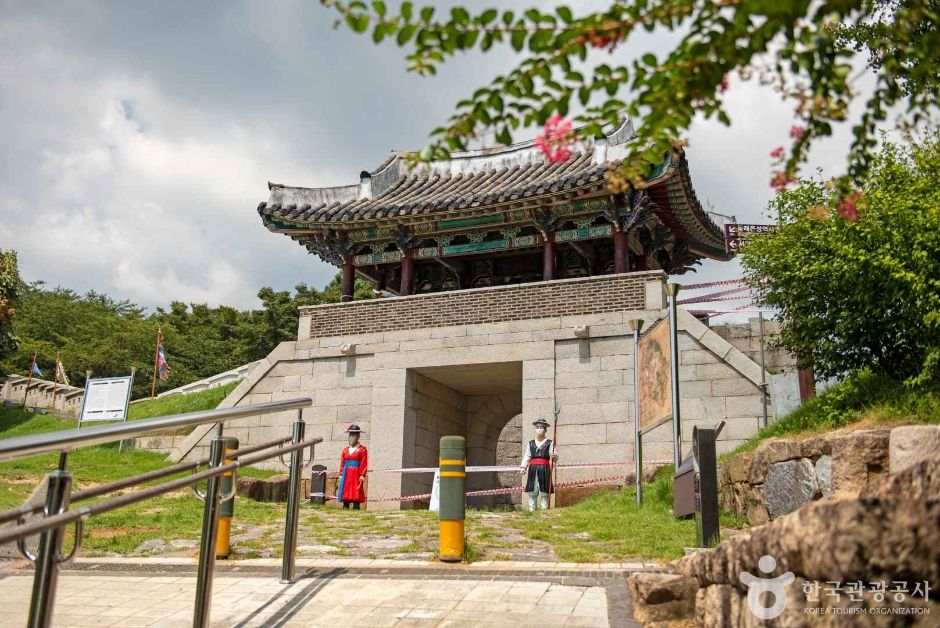
Dongnaeeupseong was a fortified town associated with the historic Dongnae administrative center. The area is especially remembered for resistance during the Japanese invasions of Korea in 1592. Today’s visit combines restored defensive structures, archaeological context, neighborhood history, and hillside walking.
This is not a fully preserved castle enclosing a tourist village. Modern Busan grew around and through the historic site. Expect reconstructed or restored sections separated by ordinary roads and neighborhoods. That mixture is part of the experience, but it requires better navigation than a single palace complex.
A short 90-minute plan
- Start near the Geumgang Park side after the village bus.
- Walk to a visible wall or gate section shown in your map app.
- Read the historical signs and spend time at one viewpoint.
- Return toward a convenient bus stop or subway access point rather than retracing every side path.
This version suits travelers interested in history but not prepared for a long hike. Wear shoes with grip and avoid wet stone stairs during heavy rain.
A half-day Dongnae history route
A longer route can connect wall sections with Bokcheon-dong ancient tombs, Bokcheon Museum, the Dongnaeeupseong History Hall area, or other Dongnae heritage sites. Confirm each facility’s closing day and final admission separately. Outdoor walls may remain accessible when a museum is closed, but that does not make the full itinerary available.
If you want a conventional indoor history museum with one clear entrance, use the Busan Museum route instead. If your priority is a central city viewpoint with little route planning, Yongdusan Park is easier.
Best season and weather
Spring and autumn offer the most comfortable walking temperatures. Summer can be hot and humid, while winter wind makes exposed sections feel colder. After rain, stone, soil, and wooden decks may be slippery. Avoid the longer route in thunderstorms, strong wind, or poor visibility.
Carry water because shop access is uneven along the trail. Use sun protection and a charged phone, and download your route before entering quieter wall sections. Start early enough to finish before dark; historic lighting does not guarantee every connecting path is well lit.
Can you combine it with another Line 1 stop?
Yes, but choose one addition. A full Dongnae history walk is already a half-day. On a shorter visit, you can return south on Line 1 and stop in central Busan. For a sunset at the opposite end of the same line, see the Dadaepo Beach guide, though combining both creates a very long day.
Common mistakes to avoid
- Searching for a single “castle entrance” instead of choosing a trail landmark.
- Boarding a village bus without checking its live direction.
- Assuming the entire historic wall survives as one continuous circuit.
- Starting a long trail late in the afternoon.
- Wearing smooth shoes on wet stone or steep paths.
- Failing to check separate museum closing days.
FAQ
How do I get from Busan Station to Dongnaeeupseong?
Take Line 1 directly to Dongnae Station, use Exit 2, then transfer to village bus Dongnae 1-1 toward the Geumgang Park side of the historic trail.
How long does the trip take?
Allow about 50–70 minutes from the KTX concourse to the trail area. Waiting for the village bus and the final walk affect the total.
Is Dongnaeeupseong free?
Outdoor wall and trail areas are generally visited as public historic spaces, but individual museums, programs, or events can have their own rules. Check each facility separately.
How long is the Dongnaeeupseong walk?
There is no single required circuit. A short wall visit can take 90 minutes, while a multi-site Dongnae history route can take three to four hours.
Is the trail suitable for luggage or strollers?
Not as a default. Slopes, stairs, stone surfaces, and separated sites make large luggage difficult. Accessibility varies by section, so choose a specific accessible landmark rather than the full trail.
Is Dongnaeeupseong worth visiting?
Yes for travelers interested in Korean history, local neighborhoods, and a less touristy walk. It is less suitable for someone expecting a fully intact castle with one entrance and extensive English interpretation.


댓글
댓글 쓰기